


In Python, unlike languages such as C, C++, Java, there isn't a built - in switch statement in the traditional sense. Python uses if - elif - else constructs to achieve similar logical branching. However, the question “Can a switch statement have multiple conditions in Python?” leads to an interesting exploration, especially when considering it from the perspective of a switch supplier. This blog post will analyze both the programming aspect and how it relates to the supply of switches.
Traditional switch Statements in Other Languages
In languages that support switch statements, a switch is often used to select one of many code blocks to be executed based on the value of an expression. For example, in Java:
int day = 3;
switch (day) {
    case 1:
        System.out.println("Monday");
        break;
    case 2:
        System.out.println("Tuesday");
        break;
    case 3:
        System.out.println("Wednesday");
        break;
    default:
        System.out.println("Another day");
}
In this simple example, the switch statement checks the value of the variable day and executes the appropriate case block. Usually, a single condition (the value of the expression) is used for each case. But in some languages, you can have multiple values associated with a single case. For example:
int num = 2;
switch (num) {
    case 1:
        System.out.println("One");
        break;
    case 2:
    case 3:
        System.out.println("Two or three");
        break;
    default:
        System.out.println("Other number");
}
Here, the case for “Two or three” has two conditions (num being equal to 2 or 3).
Python's Equivalent: if - elif - else and Multiple Conditions
Since Python doesn't have a native switch statement, it uses if - elif - else constructs. Multiple conditions can be easily incorporated into these statements. For instance:
num = 2
if num == 1:
    print("One")
elif num == 2 or num == 3:
    print("Two or three")
else:
    print("Other number")
This Python code achieves the same result as the second Java switch example above. The elif statement has a compound condition using the or logical operator. We can also use more complex conditions with and and not operators to further refine the branching logic. For example:
age = 25
income = 50000
if age >= 18 and age <= 30 and income > 40000:
    print("You are a young high - earner.")
elif age > 30 and income > 60000:
    print("You are an experienced high - earner.")
else:
    print("Your profile does not match the criteria.")
In this code, multiple conditions are combined using the and operator to create a more detailed logical check.
Relevance to a Switch Supplier
As a switch supplier, understanding programming concepts can be beneficial in several ways. Firstly, in the modern world, many switches are used in electronic devices that are controlled by software. Whether it is a Two - pedal Auto Switch in a car or a Boat Rocker Switch in a marine vessel, the operation of these switches can be tied to software logic.

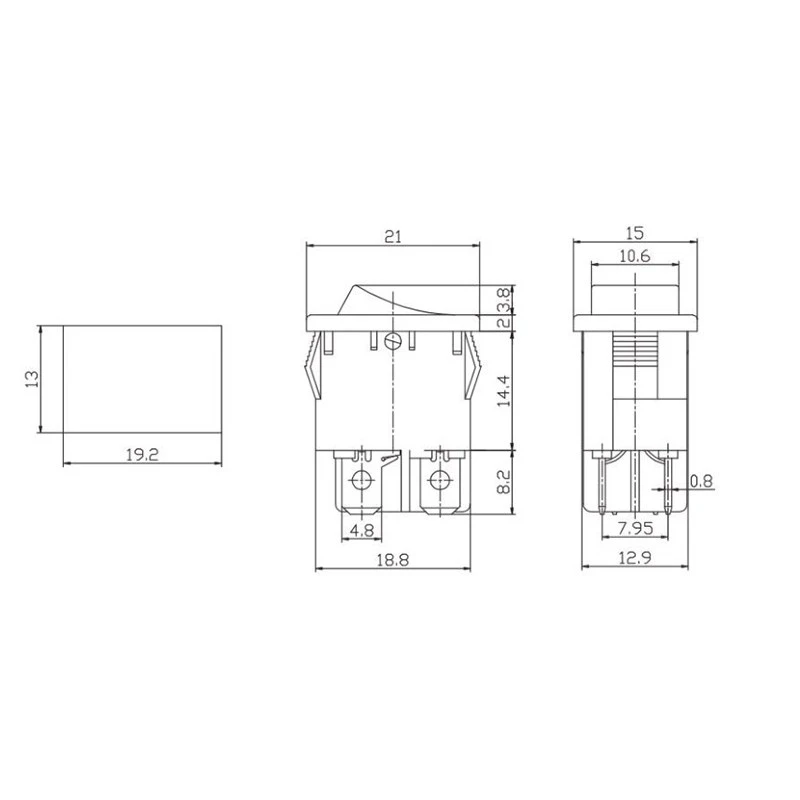
Software developers may use multiple conditions to control the state of these switches. For example, in an automotive system, an Automotive General Power Switch might be controlled based on multiple factors such as the engine temperature, the battery charge level, and the user's input. The software would use if - elif - else constructs (Python's equivalent of switch - like logic) with multiple conditions to determine when to turn the switch on or off.
Advanced Python Approaches for Switch - like Logic with Multiple Conditions
In Python, there are other ways to implement switch - like behavior with multiple conditions. One approach is to use dictionaries. Consider the following example:
def case_one():
    return "This is case one."

def case_two_three():
    return "This is either case two or three."

def default_case():
    return "This is the default case."

num = 2
switch_dict = {
    1: case_one,
    **{i: case_two_three for i in [2, 3]}
}
result = switch_dict.get(num, default_case)()
print(result)
Here, a dictionary is used to mimic a switch statement. The keys are the conditions, and the values are functions. By using dictionary comprehension ({i: case_two_three for i in [2, 3]}), we can associate multiple keys (2 and 3) with the same function, thereby handling multiple conditions.
The Business Perspective
From a switch supplier's perspective, this knowledge of programming and multiple conditions can help in product development and customer support. When working with customers who use software - controlled systems, we can provide more informed advice on how switches can be integrated into their applications. For example, if a customer is developing a custom automotive control system, we can explain how our Two - pedal Auto Switch can be incorporated into the software logic with multiple conditions to ensure safe and efficient operation.
Conclusion
In Python, while there is no native switch statement, the if - elif - else constructs and other techniques like using dictionaries allow for handling multiple conditions effectively. This programming concept has real - world implications for a switch supplier. As technology continues to evolve, the integration of software and hardware becomes more seamless. Our switches, such as the Automotive General Power Switch and Boat Rocker Switch, are part of systems that rely on complex software logic.
If you are interested in our high - quality switches and would like to discuss procurement, we welcome you to reach out. Our team of experts is ready to assist you in finding the right switches for your applications, whether they involve simple or complex multiple - condition control systems.
References
- Python Documentation. Available at docs.python.org.
- Java Language Specification. Oracle Corporation.


